
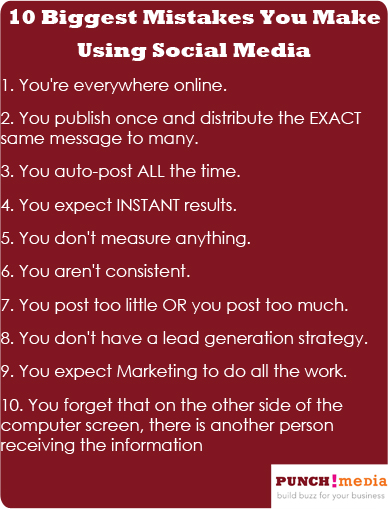
The 10 Biggest Mistakes You Make Using Social Media
I always prefer to talk about Best Practices instead of mistakes, but we can often learn from what *not* to do so that we can stay on the path to success.
1. You’re everywhere online.
Stay focused on your strategy. Be where your audience is. If you are everywhere all the time, you aren’t really connecting properly in the area where your prospects and clients want you to be.
2. You publish once and distribute the EXACT same message to many.
Not only does each Social Media site have a different etiquette and a different audience but when people see you post the *exact* same message on LinkedIn, Twitter, Facebook, etc., you look like you don’t know how to use Social Media properly.
3. You auto-post ALL the time.
Similar to point #2, you have to be present to be social. There is room for strategic “pushed” messages (sporadically) but there have been PR disasters as a result of poorly timed auto-posts.
You have to engage. You have to respond. Even if you simply thank people for their comment, you want to acknowledge they’ve spent a moment to connect with you.
4. You expect INSTANT results
Social Media is grassroots. It’s building a niche audience of people who actively want to hear what you have to say. Like a garden, it takes time to cultivate. Connect with your prospects and clients and the word-of-mouth will travel as long as you are consistently providing solutions and great results.
5. You don’t measure anything
Not looking at your metrics and results means you’re flailing around, hoping that something will stick with someone. Find out what is working, discard what isn’t working.
6. You aren’t consistent
You have to have a consistent presence to stay top-of-mind with your audience. You don’t want to set up a 1-800 hotline and then have no one there to answer the phone. Commit even 5 to 10 minutes each day just updating your status and engage with your connections. The little things you do every day amount to big results in the long run.
7. You post too little OR you post too much.
If you don’t post enough quality material, you don’t get exposure. If you post too much, you risk “hijacking” your audiences “wall” or “feed” and they will unsubscribe because you’re making too much “noise”. Find a balance.
8. You don’t have a lead generation strategy
Putting all your eggs into one Social Media basket is a recipe for disaster. Ideally you want to own the relationship with your audience. Ask for them to sign up to your newsletter, give them an awesome e-book or whitepaper in exchange for their email address. This way, if Facebook dies, or your posts aren’t reaching your prospect because of a change in the algorithm, you can still connect with them.
9. You expect Marketing to do all the work
Solving customer problems isn’t just a marketing issue, it’s a company issue. Look at your business objectives, usually it involves providing your clients with superior results. How does your company service their problems? How many touchpoints do they have? Sales, Marketing, IT, Accounts Receivable, Operations Management all contribute to the process. Are you ensuring you are solving problems from ALL aspects of your business?
For example, at a Golf & Country Club: The pros know if it’s an ideal day because they are physically on the greens. The kitchen knows what the best item on the menu is today. The marketing person is often in an office, separate from connecting with the members.
10. You forget that on the other side of the computer screen, there is another person receiving the information
I see this often. When content is pushed out, people forget that they are actually connecting human-to-human, not human-to-monitor. People vent their personal business and frustrations to what they may think is the “ether” but someone is reading what you are posting.
They way you and your company respond to any negative comments and criticism speaks volumes. Check out the disaster of Amy’s Baking Co for what NOT to do.
It’s important that your company has a Social Media policy to prevent staff from venting about your clients and misbehaving – even in their non-working hours. I’ve worked with several companies to help set the boundaries and policies for staff to ensure they are aware of acceptable behaviour on their personal accounts.
ACTION ITEM: So it’s YOUR turn to add your 2 cents. What lessons have you learned about using Social Media properly?
